Why Nuna
There are a few common ways to get data home from a remote site. Each works somewhere. None was designed for a whole Arctic field site that runs unattended through winter. Here is where we fit, and how the options compare.
Where it fits
Satellite reaches everywhere, one station at a time
A terminal at every station means its own power supply, its own airtime and its own visit when it fails.
Consumer meshes are made for people, not stations
They run on hobby boards and batteries that need recharging within weeks, and are not rated for an Arctic winter.
We built for the remote, low-power corner
Scheduled radios, power-aware routing and a self-healing mesh, tested in a climate chamber to -40°C.
Your options
Six things station operators told us they weigh up, set against each other two at a time. On every map, up and to the right is better. Where another option is the better fit, the map shows it.
Cold and delivery measured
Through a winter nobody visits
An unattended site has to survive the cold and keep delivering when something fails. Our V1 boards were tested to -40°C in a climate chamber at DTU, and the mesh reroutes around a node that drops out. A satellite link is reliable too, but a station with one terminal has one point of failure.
Reach and running cost target
One uplink for a whole site
A satellite terminal serves the station it stands at, with airtime paid every month. A LoRaWAN gateway covers its own cell and needs power and backhaul in each one. A consumer mesh costs least to buy, if you build and maintain it yourself. Serving a whole site from one uplink is a V2 design target.
Bandwidth and power target
Where a terminal is the better fit
If a station needs to send images, a satellite terminal is the right tool, and it needs the power to match. We carry sensor readings, on nodes designed to run 2 to 5 years on a battery. That battery life is a V2 design target. No option here offers both.
Show the ratings as a table
| Criterion | Nuna Systems | Satellite terminal | Consumer LoRa mesh | LoRaWAN gateways |
|---|---|---|---|---|
| How you pay | Service subscriptionreplace and repair | Terminal and airtimeper station, every month | Low hardware costyou build and maintain it | Gateway per cellplus power and backhaul |
| Power | Ultra low2 to 5 year battery target | Highterminal and heater | Mediumrecharged within weeks | Low at the sensorgateway needs steady power |
| Coverage | A whole remote site5 to 15 km per hop target | Anywhere with skyone terminal per station | Local areasshort hops | One cell per gatewaybackhaul in every cell |
| Cold | -40°Cclimate chamber at DTU measured | Cold capableheating draws power | Consumer gradebattery cold limits | Industrialrating varies |
| Delivery | Self-healing meshreroutes on its own | Reliable linkone terminal, one point of failure | Best effortmessages flooded | Acknowledgedno relaying between sensors |
| Bandwidth | Lowsensor readings, not video | Highenough for images | Lowshort messages | Lowsmall payloads |
Positions are qualitative, drawn from vendor documentation and conversations with station operators. Nuna values marked as a design target are modelled for the V2 node and have not been validated in the field. The first field deployment is planned for summer 2027.
Getting started
Switching does not mean starting over. If a station already has a satellite terminal, the mesh grows out from it, and the sensors already on site plug into our nodes. If there is nothing on site yet, we supply every part of the network.
One terminal, extended into a whole site
Measured and targeted
We keep the two apart. Measured values come from the climate chamber at DTU. Design targets are modelled for the V2 node, and each one will be replaced by a measurement once it has been observed in the field.
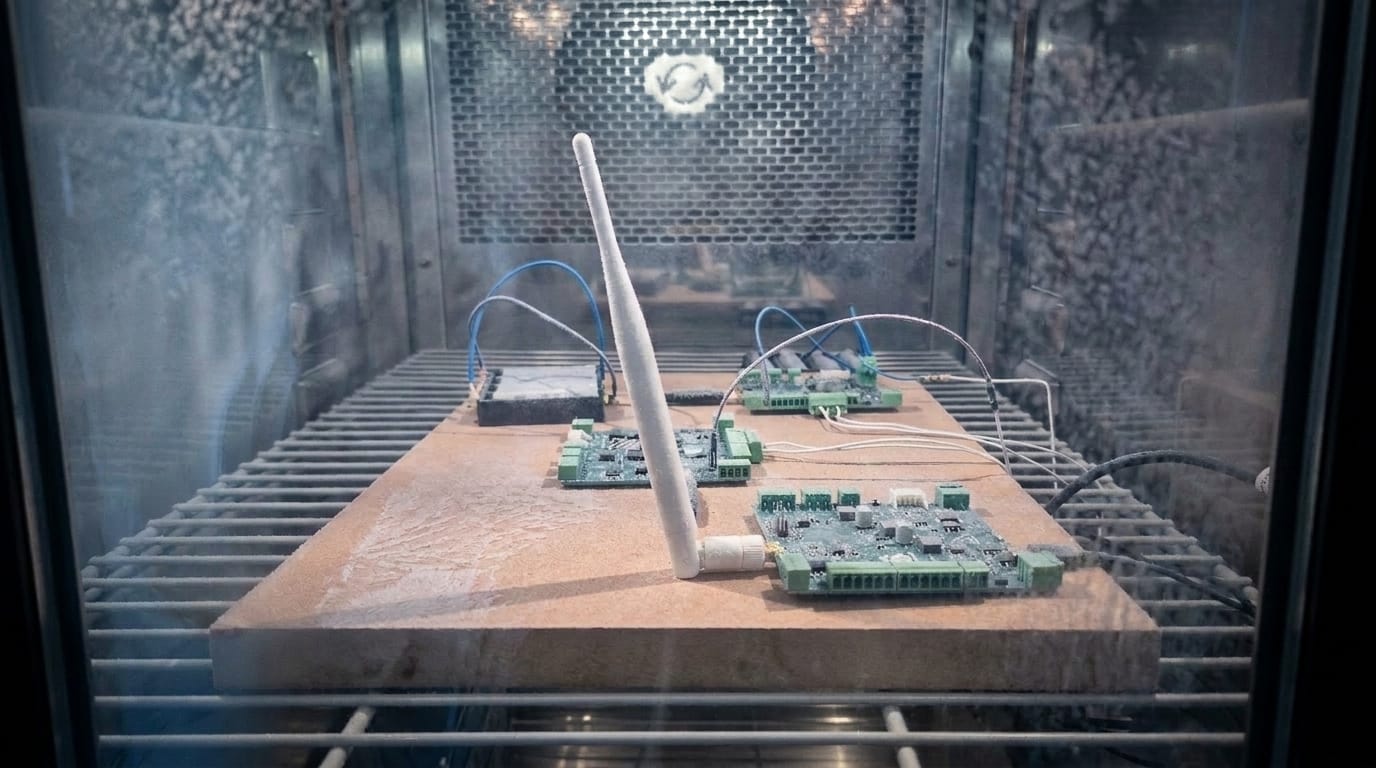
measured In the climate chamber
- In a climate chamber at DTU
- tested to minus 40 degrees Celsius
- Of about 19,600 packets acknowledged at -40°C
- over 98 percent
- Crystal clock stability
- held to 0.03 parts per million
target V2 design targets, modelled
- Battery life per node
- Target2 to 5years
- Distance per hop, depending on terrain
- Target5 to 15km
- Area one network is designed to cover
- Target~31,000km²
If you run an Arctic station or a monitoring programme, we would like to hear what you need to measure and where. Or follow the build, with occasional updates on the first field season.
We use your address to send occasional updates. You can unsubscribe from any email. See our privacy page.